
Every time you type a message into ChatGPT, something happens behind the scenes that most people never think about. A powerful computer somewhere in the world switches on, processes your request, generates a response — and uses energy and water to do it.
Now multiply that by billions of users sending billions of messages every single day.
The AI impact on environment is one of the most important conversations happening in the tech world in 2026 — and it affects all of us. In this beginner-friendly guide, you will learn exactly how AI is affecting our planet, the real numbers behind AI’s energy use, the surprising ways AI is also helping the environment, and what you can personally do about it.
Before we dive in, it helps to understand the basics — check out our guide on what artificial intelligence actually is if you are new to AI.
What Is the AI Impact on Environment? A Simple Overview
When most people think about pollution, they picture factories, cars, or plastic waste. But in 2026, there is a new and growing source of environmental pressure: artificial intelligence.
AI systems – from chatbots like ChatGPT to image generators and recommendation algorithms — all run on massive computers called data centers. These data centers need three things in huge quantities:
- Electricity — to power the servers and run AI calculations
- Water — to cool the servers and prevent overheating
- Hardware — physical chips, GPUs, and servers that require rare minerals to build
The environmental impact of AI comes from the production, operation, and disposal of all of these. To understand it fully, let us look at each one in detail.
How Does AI Actually Use Energy?
AI uses energy at two main stages:
- Training — when an AI model learns from billions of data points. This is extremely energy-intensive and happens once (or periodically).
- Inference — every time you use an AI tool and it generates a response. This happens billions of times per day across all users.
To understand how AI works at a deeper level, our beginner’s guide breaks it down in simple terms. The key point is: both training and inference use significant amounts of electricity — and that electricity often comes from power plants that burn fossil fuels.
Why Are Data Centers at the Centre of This Problem?
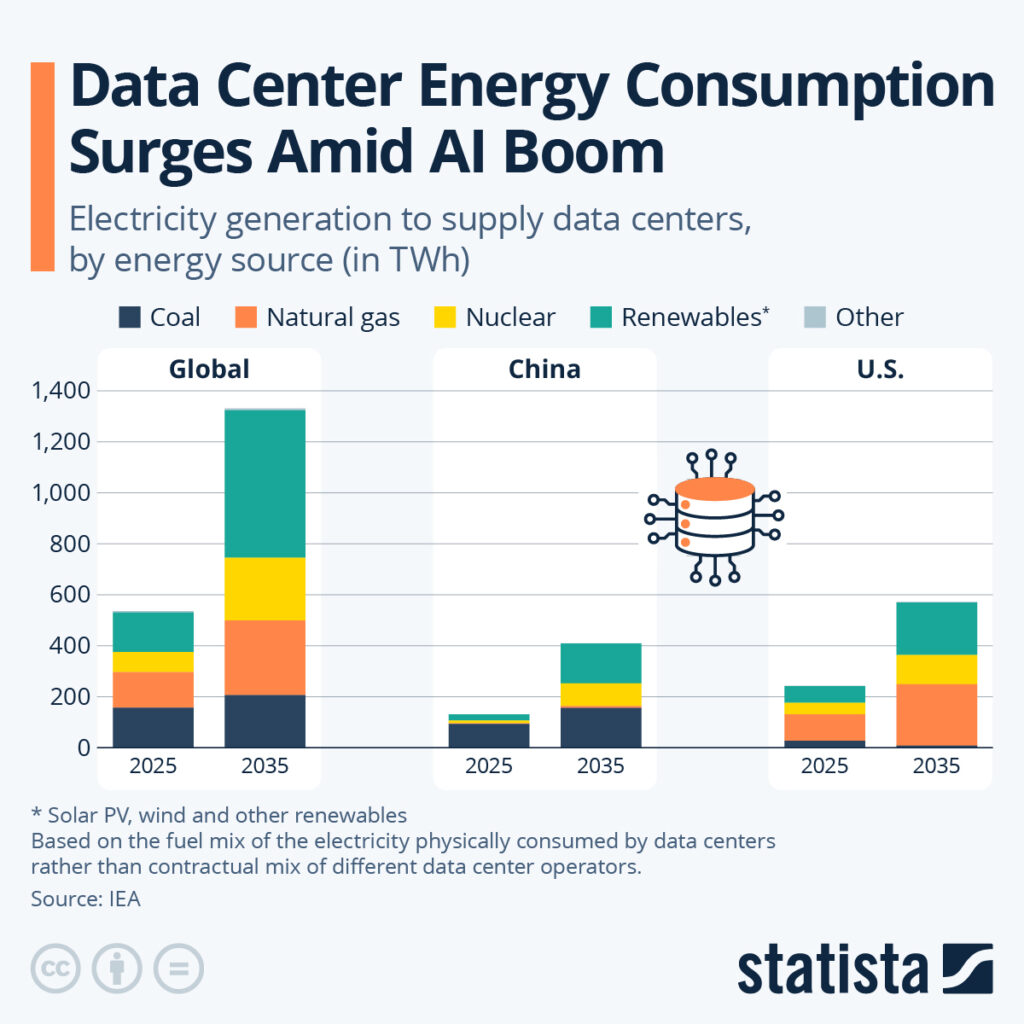
Data centers are the buildings that house the computers running AI. In 2026, these facilities have become some of the largest electricity consumers on the planet.
- Global data center electricity consumption reached approximately 415 TWh in 2024 — about 1.5% of total global electricity use
- This figure is growing at 12–15% per year — four times faster than overall global electricity demand
- By 2030, data centers are projected to consume 945 TWh — nearly double today’s usage
- A generative AI training cluster uses 7 to 8 times more energy than a standard computing workload
To put that in perspective: if data centers were a country, they would already be one of the top 10 electricity consumers in the world – sitting between Japan and Russia.
AI Impact on Environment: Energy Consumption and Carbon Footprint
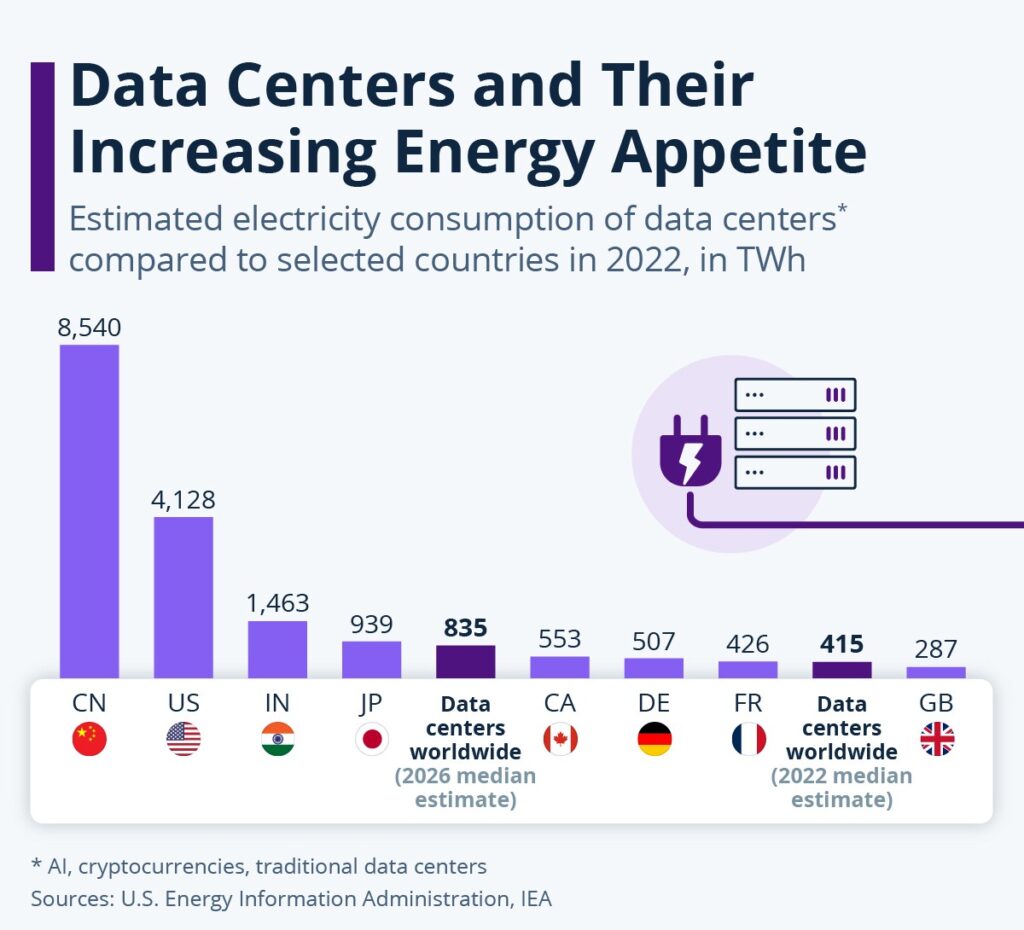
The environmental impact of AI is clearest when we look at actual numbers. Here is what the data tells us in 2026.
How Much Energy Does a Single AI Prompt Use?
You might be surprised to learn how much energy goes into one simple AI interaction:
- A single ChatGPT query uses approximately 0.34 Wh of electricity — about 5 to 10 times more than a standard Google Search
- A Google Gemini text prompt uses roughly 0.24 Wh — equivalent to watching nine seconds of television
- An AI image generation request uses an average of 2.91 Wh — the most energy-intensive common AI task
- Training GPT-4 consumed over 50 GWh — enough electricity to power approximately 20,000 US homes for an entire year
Individually, these numbers seem small. But when billions of people send billions of prompts every day, the collective impact becomes enormous.
AI’s Carbon Emissions: The Numbers That Should Concern Us
Carbon emissions from AI are directly linked to how the electricity powering data centers is generated. In regions that rely heavily on coal and gas, AI’s carbon footprint is significantly higher.
- The AI boom in 2025 released CO2 roughly equivalent to New York City’s entire annual emissions
- AI servers in the US alone are expected to add 24 to 44 million metric tons of CO2 by 2030
- Training a single large AI model can produce approximately 626,000 pounds of carbon dioxide — nearly five times the lifetime emissions of the average car
- Microsoft and Meta both reported significant increases in their carbon footprints in recent years, directly attributing this to AI infrastructure expansion
Water Consumption: The Hidden Environmental Cost of AI
Energy and carbon get most of the attention — but water is the hidden environmental cost of AI that most people never talk about.
Data centers use enormous amounts of water to cool their servers. Without cooling, the machines would overheat and shut down.
- AI globally consumed approximately 17 billion gallons of water in 2026
- Every 20 to 50 AI prompts you send require approximately 500ml of water for cooling
- In the United States, AI servers are projected to increase annual water consumption by 200 to 300 billion gallons by 2030
- In Ireland, data centers already account for 21% of national electricity use — and could reach 35% by 2026 due to AI growth
In many parts of the world, water scarcity is already a crisis. The fact that AI data centers are consuming water at this scale — often in dry regions — makes this a serious concern.
Environmental Impact of AI: The Risks You Cannot Ignore
Beyond energy, carbon, and water — there are other environmental risks from AI that are growing in 2026.
E-Waste: The Growing Hardware Problem
Every AI data center is filled with physical hardware — GPUs, servers, cooling systems — that eventually becomes electronic waste (e-waste). And the pace of AI development is speeding up this cycle dramatically.
- AI demand has shortened the server refresh cycle from 5 years to just 3 years — increasing e-waste by 25%
- Annual AI hardware production generates approximately 50,000 tons of e-waste globally
- NVIDIA, AMD, and Intel shipped approximately 3.85 million GPUs to data centers in 2023 alone
- Each GPU produces approximately 5kg of e-waste at the end of its life
- Of the 62 million tonnes of e-waste produced globally in 2022, less than one quarter was properly recycled
Land Use: How Big Are AI Data Centers?
Building a single AI hyperscale data center requires approximately 500,000 tons of concrete, emitting 400,000 tons of CO2 in the construction process alone. The global data center land footprint doubled to 2,000 square kilometres between 2020 and 2023 — and it is still growing.
Does Character AI Harm the Environment?
This is a question many users are now asking. The short answer is: yes, like all AI chatbots, Character AI does contribute to environmental impact — though its individual footprint per interaction is relatively small.
Every time you chat with Character AI, the message is processed by servers that consume electricity and water. With millions of users sending messages daily, the collective environmental cost of Character AI — and similar platforms like ChatGPT, Gemini, and Claude — adds up to a significant total.
The key issue is not one person’s usage — it is the scale of millions of simultaneous users that creates the environmental pressure. This is why AI companies are under increasing pressure to power their data centers with renewable energy.
The Surprising Environmental Benefits of AI in 2026
Here is the part of the story that often gets overlooked: AI is also one of our most powerful tools for fighting environmental problems. The same technology that consumes energy is also being used to save it.
How AI Is Helping Fight Climate Change
Scientists and engineers are using AI to tackle climate change in ways that were previously impossible:
- Climate modelling — AI can process decades of climate data and predict extreme weather events earlier and more accurately than traditional methods
- Energy grid optimization — AI predicts solar and wind energy output in real time, helping grid operators reduce wasted energy
- Carbon capture — AI is being used to accelerate the discovery of new materials that can capture CO2 from the atmosphere more efficiently
- Wildfire prediction — AI satellite tools can detect early signs of wildfire and help governments respond before fires spread
AI in Renewable Energy: Smarter Grids and Solar Forecasting
One of AI’s most impactful environmental contributions is in the energy sector itself. AI-powered smart grids can:
- Predict exactly when solar panels will produce peak power — and balance the grid accordingly
- Reduce energy waste by routing electricity more efficiently across networks
- Identify patterns in energy consumption and automatically reduce usage during low-demand periods
Google’s DeepMind AI famously reduced the energy used for cooling in Google’s own data centers by 40% — proving that AI can be used to reduce its own environmental footprint.
AI for Wildlife Conservation and Forest Protection
AI is being used by conservation organizations around the world to protect nature:
- AI satellite analysis can detect illegal deforestation in real time — alerting authorities before large areas of forest are destroyed
- AI listening devices in forests can identify the sounds of chainsaws and alert rangers immediately
- AI is being used to track endangered species populations and migration patterns more accurately than ever
- The UN Environment Programme uses AI to map methane emissions and track sand dredging that damages ocean ecosystems
Real-World Case Studies: AI and the Environment
Case Study 1: Google DeepMind Cuts Cooling Energy by 40%
Google trained a DeepMind AI to manage the cooling systems in its data centers. The result was a 40% reduction in cooling energy use — saving enormous amounts of electricity and reducing Google’s carbon footprint significantly. This same approach is now being applied to data centers around the world.
Case Study 2: DeepSeek-V3 — 95% Lower Energy Than GPT-4
In 2025, the AI model DeepSeek-V3 demonstrated that powerful AI does not have to be energy-hungry. Using advanced techniques like Mixture-of-Experts architecture, DeepSeek achieved 95% lower energy use than GPT-4 while maintaining competitive performance. This breakthrough showed the industry that efficiency and capability can go together — and sparked a new wave of energy-efficient AI research.
Case Study 3: Microsoft’s Sustainability Pledge
Microsoft has committed to becoming carbon negative by 2030 — meaning it will remove more carbon from the atmosphere than it emits. As part of this commitment, Microsoft is investing in renewable energy for its data centers and developing AI tools specifically designed to help other companies reduce their own carbon emissions.
Perplexity AI Environmental Impact: Is Your Favourite AI Search Tool Green?
Many of our readers use Perplexity AI for research — so what is the Perplexity AI environmental impact compared to other tools?
How Much Energy Does Perplexity AI Use Per Search?
Perplexity AI searches the web in real time and synthesizes results from multiple sources before giving you an answer. This means each Perplexity query involves:
- A web crawl across multiple pages
- AI processing to read and summarize results
- Generation of a cited, structured answer
This is more complex than a simple chatbot response — which means it likely uses slightly more energy per query than a tool like ChatGPT for a basic question. However, Perplexity replaces the need to open and read 5–10 different web pages, which also consume energy. The net environmental impact is difficult to calculate precisely, as Perplexity has not publicly disclosed specific per-query energy figures.
Comparing the Carbon Footprint of Popular AI Tools
| AI Tool | Energy Per Prompt (approx) | Renewable Energy Commitment |
|---|---|---|
| ChatGPT (GPT-4o) | 0.3–0.42 Wh | OpenAI working toward clean energy |
| Google Gemini | ~0.24 Wh | Google: 100% renewable energy matched |
| Perplexity AI | Not publicly disclosed | Hosted on cloud providers |
| AI Image Generation | ~2.91 Wh average | Varies by provider |
| Google Search | ~0.03–0.07 Wh | Google: 100% renewable energy matched |
The takeaway: Google Gemini is currently one of the greener AI options, as Google has made significant investments in renewable energy and improved its software efficiency — reducing the carbon emissions per Gemini prompt by a factor of 44 over the past year.
Sustainable AI: How Companies Are Reducing AI’s Impact on Environment
The good news is that major AI companies are taking the environmental impact of AI seriously — and making real progress.
Renewable Energy Powered Data Centers
Several major tech companies are now committing to powering their data centers entirely with renewable energy:
- Google matches 100% of its electricity use with renewable energy purchases
- Microsoft is investing billions in new nuclear and solar energy for AI infrastructure
- Amazon is building renewable energy projects specifically to power AWS data centers
Smaller, Smarter Models: The Efficiency Revolution
One of the most promising trends in 2026 is the shift toward smaller, more efficient AI models. Instead of building ever-larger models that consume more energy, researchers are finding ways to achieve the same results with much less computation.
DeepSeek-V3 proved this is possible. And the ISO has developed new Sustainable AI Standards in 2026 — international guidelines that encourage AI companies to measure, report, and reduce the environmental footprint of their products.
Location Matters: Where Data Centers Are Built
Research shows that the location of a data center can cut its combined environmental footprint by nearly half. Data centers built in:
- Countries with clean energy grids (like Iceland — powered almost entirely by geothermal and hydro)
- Cool climates (which reduce water needed for cooling)
- Water-secure regions (to avoid draining scarce local water resources)
…have dramatically lower environmental impacts than those built in warm, water-stressed regions powered by fossil fuels.
The Future of AI and the Environment: What to Expect by 2030
The trajectory of AI’s environmental impact over the next few years will depend on two competing forces: growing demand for AI and improving efficiency of AI systems.
Will AI’s Energy Use Keep Growing?
Yes — at least in the short term. The International Energy Agency (IEA) projects that global data center electricity demand will grow from 415 TWh in 2024 to 945 TWh by 2030. This growth is primarily driven by AI adoption.
However, the picture is not entirely bleak. The Paris Agreement includes a target of 53% reduction in data center emissions by 2030. And breakthrough efficiency improvements — like DeepSeek’s 95% energy reduction — show that this goal is achievable if the industry commits to it.
Can AI Save the Planet While Also Harming It?
This is the central paradox of AI and the environment in 2026. The same technology that is contributing to carbon emissions is also our most powerful tool for fighting climate change.
The answer lies in how we develop and use AI. If the energy powering AI comes from renewable sources, and if AI systems are designed to be efficient, the technology’s benefits — accelerating climate science, optimizing energy grids, protecting forests — can far outweigh its costs.
As one expert from the UN Environment Programme put it: the conversation about AI and the environment is just beginning — and having it is an essential first step.
What Can You Do to Reduce AI’s Environmental Impact?
You might be thinking: “I am just one person. Can my choices really make a difference?” The answer is yes — especially when millions of people make the same choices together.
Here is what you can do right now:
- Use AI intentionally — avoid sending unnecessary or repetitive prompts. Every query counts.
- Choose greener AI tools — Google Gemini, for example, is backed by significant renewable energy investment
- Avoid AI image generation for casual use — it uses nearly 10 times more energy than a text prompt
- Support sustainable tech policies — vote for and support legislation that requires data centers to report their energy and water use
- Stay informed — the more people understand AI’s environmental cost, the more pressure companies face to reduce it
Pro Tip: The Greenest AI Habit You Can Build in 2026
Before sending an AI prompt, ask yourself: “Do I actually need AI for this — or can I do it myself in the same amount of time?”
For simple tasks — like quick calculations, basic searches, or decisions you already know the answer to — skipping the AI entirely is the greenest choice. Reserve AI for tasks where it genuinely saves significant time or produces significantly better results.
This habit alone — if adopted by millions of users — could meaningfully reduce the collective environmental footprint of AI in 2026.
Frequently Asked Questions
Q1. What is the AI impact on environment in 2026?
In 2026, AI has a significant environmental impact through electricity consumption, carbon emissions, water use, and e-waste. Data centers powering AI consumed 415 TWh of electricity in 2024 — projected to nearly double by 2030. AI also consumed approximately 17 billion gallons of water globally for cooling. However, AI is also helping fight climate change through smarter energy grids, climate modelling, and forest protection.
Q2. Does Character AI harm the environment?
Yes — like all AI chatbots, Character AI contributes to environmental impact through the energy consumed each time a message is processed. Individually, the impact per message is small. But at scale — with millions of users sending billions of messages daily — the collective footprint is significant. The environmental impact of Character AI is similar to that of ChatGPT, Gemini, and other AI chat platforms.
Q3. What is the Perplexity AI environmental impact?
Perplexity AI searches the web in real time before generating answers, which likely makes it slightly more energy-intensive per query than a simple chatbot response. However, Perplexity has not publicly disclosed specific per-query energy figures. On the positive side, using Perplexity replaces the need to open and read multiple separate web pages — which also consume energy. The net environmental impact compared to a traditional Google search is hard to calculate precisely.
Q4. What is the environmental impact of AI on climate change?
AI has a two-sided impact on climate change. Negatively, AI data centers emit millions of tons of CO2 annually and consume vast amounts of water. Positively, AI is being used to accelerate climate science, optimize renewable energy grids, detect deforestation in real time, and develop new carbon capture materials. The long-term climate impact of AI will depend on whether its energy comes from clean sources and whether efficiency improvements keep pace with growing demand.
Q5. Can AI help solve environmental problems?
Yes — AI is already helping solve environmental problems in powerful ways. Google’s DeepMind AI cut data center cooling energy by 40%. AI satellite tools detect illegal deforestation in real time. AI helps energy companies predict solar and wind output more accurately, reducing wasted electricity. AI is also being used to accelerate the discovery of new climate-friendly materials and predict extreme weather events earlier and more accurately.
Q6. How can I reduce my personal AI carbon footprint?
You can reduce your personal AI carbon footprint by using AI tools intentionally — only when they genuinely add value. Avoid unnecessary or repetitive prompts. Choose AI tools backed by renewable energy, like Google Gemini. Avoid energy-intensive tasks like AI image generation for casual use. Stay informed and support policies that push AI companies toward greater transparency and sustainability in their energy use.
Conclusion: The AI Impact on Environment Is Real — But So Is the Solution
The AI impact on environment is real, significant, and growing. In 2026, AI consumes as much electricity as entire nations, uses billions of gallons of water, and generates tens of thousands of tons of e-waste every year.
But AI is also one of our most powerful tools for fighting the very environmental problems it contributes to. The key is in how we build, power, and use these systems.
Here is the most important takeaway: AI’s environmental future is not yet written. The choices made by companies, governments, and individual users in the next few years will determine whether AI becomes a net positive or negative force for the planet.

I’m an SEO specialist with 7+ years of experience in search engine optimization, digital marketing, content strategy, and AI-powered marketing. I share practical insights on AI tools, SEO, automation, content marketing, and emerging technologies to help businesses and marketers improve their online presence and stay ahead of the latest digital trends.