
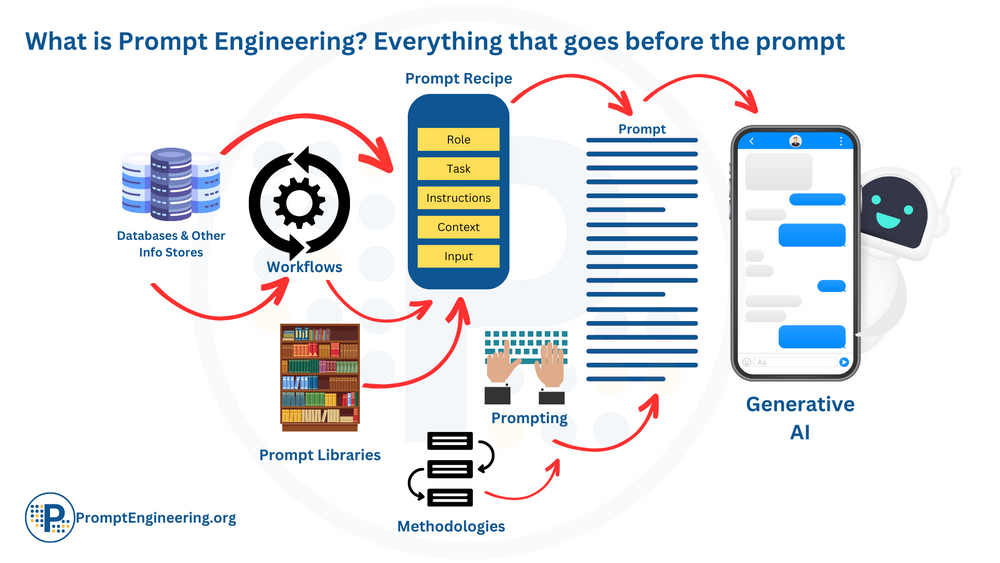
Prompt engineering is the skill of writing clear, structured instructions — called prompts — to guide AI tools like ChatGPT, Gemini, or Claude to produce the exact output you want.
Think of it this way: AI is an incredibly powerful engine. But like any engine, it needs the right fuel to run properly. Your prompt is that fuel. The better your prompt, the better your results.
A prompt engineer is someone who has mastered the art and science of writing these instructions. They understand how AI thinks, what it responds to best, and how to frame requests in a way that consistently produces high-quality, accurate, and useful outputs.
What is a Prompt?
A prompt is simply the text you type into an AI tool. It is your instruction, your question, or your request.
Here is the difference between a weak prompt and a strong one:
- ❌ Weak prompt: “Write something about AI.”
- ✅ Strong prompt: “Write a 300-word beginner-friendly blog introduction about artificial intelligence for a US audience aged 18–35. Use simple language, a conversational tone, and include one real-life example.”
The second prompt gives the AI context, a target audience, a word count, a tone, and a specific requirement. The result will be dramatically better.
💡 Prompt engineering is the art of giving AI the right instructions to get the best results
Why is Prompt Engineering Important?
In 2026, AI tools are everywhere — in businesses, schools, hospitals, and homes. But most people are getting only 20–30% of the value these tools can offer, simply because they do not know how to prompt effectively.
Here is why prompt engineering matters:
- ✅ It gets you better, more accurate AI responses every time
- ✅ It saves hours of back-and-forth trial and error
- ✅ It helps businesses automate tasks more effectively
- ✅ It is becoming a required skill in dozens of job roles
- ✅ It is one of the highest-paying skills in the AI industry
📊 Stat: The demand for prompt engineers surged by 135.8% in 2025. The global prompt engineering market is valued at $1.52 billion in 2026 and growing at a 32.10% CAGR. — Source: SQ Magazine
Types of Prompts in AI
Not all prompts are the same. Different situations call for different types of prompts. Understanding the main types of prompts will help you use AI tools far more effectively.
1. Informational Prompts
These prompts ask AI to explain, define, or teach something.
Example: “Explain how machine learning works in simple terms for a complete beginner.”
Best for: Learning new topics, research, answering questions
2. Instructional Prompts
These prompts tell AI to complete a specific task — step by step.
Example: “Write a 500-word product description for a wireless Bluetooth headphone targeting college students in the USA. Highlight sound quality, battery life, and price value.”
Best for: Writing tasks, content creation, coding, summarizing
3. Conversational Prompts
These prompts engage AI in a back-and-forth dialogue — similar to chatting with a person.
Example: “I want to start a YouTube channel about AI. Ask me questions to help me figure out my niche.”
Best for: Brainstorming, decision-making, exploring ideas
4. Creative Prompts
These prompts ask AI to create — stories, poems, scripts, slogans, and more.
Example: “Write a 60-second YouTube Shorts script about the top 3 free AI tools for students. Make it energetic, fast-paced, and end with a strong call to action.”
Best for: Content creators, marketers, writers, social media managers
5. Role-Based Prompts
These prompts assign AI a specific role or persona before giving it a task.
Example: “You are an experienced SEO expert with 10 years of experience. Review this blog title and suggest 5 better alternatives optimized for Google search in 2026.”
Best for: Getting expert-level responses, professional writing, specialized tasks
What is Prompt Theory?
Prompt theory is the study of how and why certain prompt structures produce better AI responses. It is the science behind prompt engineering.
Understanding how AI works under the hood helps you understand why prompt theory matters — because AI responds to patterns, context, and structure in very specific ways.

Here are the three most important concepts in prompt theory that every beginner should know:
Zero-Shot Prompting
You give AI a task with no examples — just a clear instruction. You are asking the AI to figure it out from scratch based on what it already knows.
Example: “Translate this sentence into French: ‘AI is changing the world.'”
When to use it: Simple, straightforward tasks where context is clear
Few-Shot Prompting
You give AI two to three examples of what you want before asking it to complete the task. This teaches the AI your expected format and style.
Example:
- Input: “dog” → Output: “A loyal four-legged companion”
- Input: “car” → Output: “A four-wheeled machine for transportation”
- Now do: “laptop” → ?
When to use it: When you need consistent formatting, tone, or style across multiple outputs
Chain-of-Thought Prompting
You ask AI to think through a problem step by step before giving its final answer. This dramatically improves AI performance on complex reasoning tasks.
Example: “Think step by step: If a train leaves New York at 9am traveling at 60mph, and another leaves Boston at 10am traveling at 80mph toward New York, and the distance between them is 215 miles — when do they meet?”
When to use it: Maths, logic problems, complex decisions, analysis tasks
OpenAI Prompt Engineering Explained
OpenAI prompt engineering refers to the specific techniques and best practices used when working with OpenAI’s models — including ChatGPT (GPT-4o), GPT-4, and the GPT API used by developers to build AI-powered apps.
OpenAI has published its own official prompting guidelines, and here are the key best practices their experts recommend:
- Be specific and detailed — the more context you give, the better the output
- Assign a role — start with “You are a [role]” to set the right tone and expertise
- Specify the format — tell the AI if you want a list, a table, paragraphs, bullet points, or JSON
- Set the audience — “Explain this to a 10-year-old” vs “Explain this to a PhD researcher” produces very different results
- Use delimiters — use quotation marks, brackets, or triple dashes to clearly separate your instructions from your content
- Iterate and refine — great prompts rarely come on the first try; test, adjust, and improve
OpenAI prompt engineering is especially important for developers building AI-powered products — customer service chatbots, writing assistants, code generators, and data analysis tools all rely on carefully engineered prompts to function properly.
AI Prompt for Expert Web Development
One of the most practical applications of prompt engineering in 2026 is web development. Developers — from beginners to senior engineers — are using AI prompts for expert web development to build faster, debug smarter, and deliver better results for clients.

Examples of AI Prompts for Web Development
Generate HTML/CSS:
“Create a clean, responsive navigation bar in HTML and CSS for a modern SaaS website. It should include a logo on the left, five menu items in the center, and a ‘Get Started’ CTA button on the right. Make it mobile-friendly with a hamburger menu on screens under 768px.”
Debugging Code:
“Here is my JavaScript code: [paste code]. It is throwing a ‘cannot read property of undefined’ error on line 47. Identify the bug, explain why it is happening, and give me the corrected code.”
SEO Optimization:
“Review this page’s HTML: [paste code]. Identify 5 specific SEO improvements I can make — including meta tags, heading structure, alt text, and page speed suggestions.”
Benefits for Freelancers and Agencies
- Complete client projects 2–3x faster with AI-assisted coding
- Reduce debugging time by 50%+ using AI to identify and fix errors
- Generate boilerplate code instantly — focus your energy on custom logic
- Deliver better SEO and accessibility scores for clients without extra effort
How to Become a Prompt Engineer
Here is the question everyone is asking in 2026: how to become a prompt engineer?
The good news: you do not need a computer science degree. You do not need to know how to code (though it helps). What you need is curiosity, strong communication skills, and a willingness to experiment.

Skills Required to Become a Prompt Engineer
- Logical thinking — ability to break complex problems into clear, structured steps
- Strong writing skills — prompts are written instructions; clear writing produces clear results
- AI understanding — knowing how large language models work helps you prompt them more effectively
- Attention to detail — small changes in wording can dramatically change AI output
- Creativity — the best prompt engineers think creatively about how to frame problems
- Python (optional but valuable) — coding skills can add $20,000–$40,000 to your salary
Tools to Learn
- ChatGPT — the most widely used AI tool; essential starting point
- Claude by Anthropic — excellent for long-form content and nuanced reasoning
- Google Gemini — integrated with Google Workspace; great for research
- Midjourney / DALL-E — for AI image prompting
- LangChain — for developers building AI-powered applications
- PromptBase — a marketplace where you can buy and sell prompts
Step-by-Step Roadmap to Become a Prompt Engineer
- Step 1: Learn the basics of AI
Read beginner guides (like ours at Write For Us Today). Understand what AI is, how it works, and what large language models do. - Step 2: Start practicing prompts daily
Open ChatGPT and experiment every day. Try different types of prompts. Test zero-shot, few-shot, and chain-of-thought techniques. Keep a notebook of prompts that work well. - Step 3: Take a structured course
Platforms like Coursera, DeepLearning.AI, and Vanderbilt University offer free and paid prompt engineering courses. The Prompt Engineering Specialization on Coursera is highly recommended. - Step 4: Build a portfolio
Document your best prompts and their outputs. Create case studies showing how you used prompt engineering to solve real problems — content creation, coding, customer service, etc. - Step 5: Freelance or apply for jobs
Start on platforms like Upwork or Fiverr offering prompt engineering services. Apply for AI-related roles on LinkedIn using keywords like “prompt engineer,” “AI content specialist,” and “generative AI engineer.”
How Much Does a Prompt Engineer Earn in 2026?
| Experience Level | Annual Salary (USA) |
|---|---|
| Entry Level (0–2 years) | $90,000 – $125,000 |
| Mid Level (2–5 years) | $130,000 – $175,000 |
| Senior Level (5+ years) | $170,000 – $220,000 |
| Top Earners (with equity) | $500,000+ |
Source: PE Collective Salary Tracker, Glassdoor — April 2026

Benefits of Prompt Engineering
- 🎯 Better AI output quality — structured prompts reduce AI errors by up to 76%
- ⏱️ Saves time and cost — tasks that took hours now take minutes
- 🤖 Enables powerful automation — well-engineered prompts power entire business workflows
- 💰 High-paying career — average salary of $126,000/year with rapid growth
- 🌍 Remote-friendly — most prompt engineering roles can be done from anywhere
- 📈 Future-proof skill — as AI adoption grows, prompt engineering demand grows with it
Common Mistakes in Prompt Engineering
Even experienced users make these mistakes. Avoid them and you will immediately get better results from every AI tool you use:
- ❌ Writing vague prompts — “Write about marketing” tells AI almost nothing. Always be specific.
- ❌ Forgetting context — AI has no memory of who you are or what you need. Give background every time.
- ❌ Ignoring format instructions — if you need a table, a bullet list, or a specific word count — say so explicitly.
- ❌ Not testing variations — the first prompt is rarely the best. Try 3–5 versions and compare results.
- ❌ Making prompts too long — more words is not always better. Focus on clarity over length.
- ❌ Not assigning a role — starting with “You are a [role]” dramatically improves response quality.
Conclusion: Prompt Engineering is the Skill of the AI Era
We are living through one of the biggest technological shifts in human history. AI is changing how we work, learn, create, and communicate and prompt engineering is the key that unlocks AI’s full potential.
Whether you want to use AI more effectively in your daily life, advance your career, or build a new income stream — learning prompt engineering is one of the best investments you can make in 2026.
Here is your action plan to get started today:
- ✅ Open ChatGPT and try writing a role-based prompt for something you need help with
- ✅ Practice the five types of prompts — one each day this week
- ✅ Try chain-of-thought prompting on a complex problem you are working on
- ✅ Enroll in a free prompt engineering course on Coursera or DeepLearning.AI
- ✅ Start building your prompt portfolio — document what works
The best prompt engineers are not necessarily the most technical people — they are the most curious ones. If you are willing to experiment, learn, and keep refining your skills, there has never been a better time to get started.
Want to keep learning about AI in simple, beginner-friendly language? Explore more guides on Write For Us Today:
Frequently Asked Questions (FAQs)
Q1. What is a prompt in AI?
A prompt in AI is the text input you provide to an AI tool — your question, instruction, or request. It tells the AI what you want it to do. The quality of your prompt directly determines the quality of the AI’s response. A well-crafted prompt gives the AI clear context, a specific task, a target audience, and the desired format.
Q2. What does prompt mean in simple words?
In simple words, a prompt is just an instruction you give to an AI. Think of it like texting a very smart assistant. If you text “help me” they do not know what to do. But if you text “help me write a birthday message for my best friend who loves hiking and coffee” — they can give you exactly what you need. That detailed message is your prompt.
Q3. What are the types of prompts in AI?
The main types of prompts in AI are: informational prompts (asking AI to explain something), instructional prompts (giving AI a specific task), conversational prompts (having a back-and-forth dialogue), creative prompts (asking AI to write stories, scripts, or slogans), and role-based prompts (assigning AI a specific persona or expertise before giving a task). Each type produces different kinds of results.
Q4. What is AI prompting?
AI prompting is the act of writing and sending prompts to an AI tool to get a desired output. It is the fundamental way humans communicate with AI systems like ChatGPT, Gemini, and Claude. Good AI prompting is a skill — the better you get at writing prompts, the more powerful and useful AI becomes for you personally and professionally.
Q5. What is prompt theory?
Prompt theory is the study of how different prompt structures affect AI responses. It covers techniques like zero-shot prompting (giving no examples), few-shot prompting (giving 2–3 examples), and chain-of-thought prompting (asking AI to reason step by step). Understanding prompt theory helps you consistently get better, more accurate results from any AI tool.
Q6. How to become a prompt engineer?
To become a prompt engineer, start by learning the basics of AI and large language models. Then practice writing prompts daily using ChatGPT or other AI tools. Take a structured online course — Coursera and DeepLearning.AI both offer excellent prompt engineering programs. Build a portfolio of your best prompts and results. Then look for freelance opportunities on Upwork or apply for AI-related jobs on LinkedIn. You do not need a computer science degree — about 40% of professional prompt engineers come from non-technical backgrounds.
Q7. What is OpenAI prompt engineering?
OpenAI prompt engineering refers to the techniques and best practices for getting the best results from OpenAI’s AI models — including ChatGPT (GPT-4o) and the GPT API. Key practices include being specific and detailed, assigning roles, specifying output format, setting the target audience, and using delimiters to clearly separate instructions from content. OpenAI has published official prompting guidelines that are freely available and highly recommended for anyone using their tools.

I’m an SEO specialist with 7+ years of experience in search engine optimization, digital marketing, content strategy, and AI-powered marketing. I share practical insights on AI tools, SEO, automation, content marketing, and emerging technologies to help businesses and marketers improve their online presence and stay ahead of the latest digital trends.