

When it comes to how to optimize for AI overviews, there is a lot worth knowing before you get started.
The search world is changing fast, and how people find stuff online is right at the heart of it. Google’s new AI Overviews, which used to be part of the Search Generative Experience (SGE), are a pretty big deal, moving away from the old search result pages we’re used to. These AI summaries at the top of search results aren’t just a new feature; they’re fundamentally changing how users search and presenting a whole new challenge for search engine optimization (SEO). For businesses, content creators, and anyone who depends on getting organic traffic, figuring out how to adapt isn’t optional anymore. This guide will give you the knowledge and strategies you need to navigate this evolving search space and make sure your content gets seen in this new era of AI-powered search.
What Are Google AI Overviews and How Do They Work?
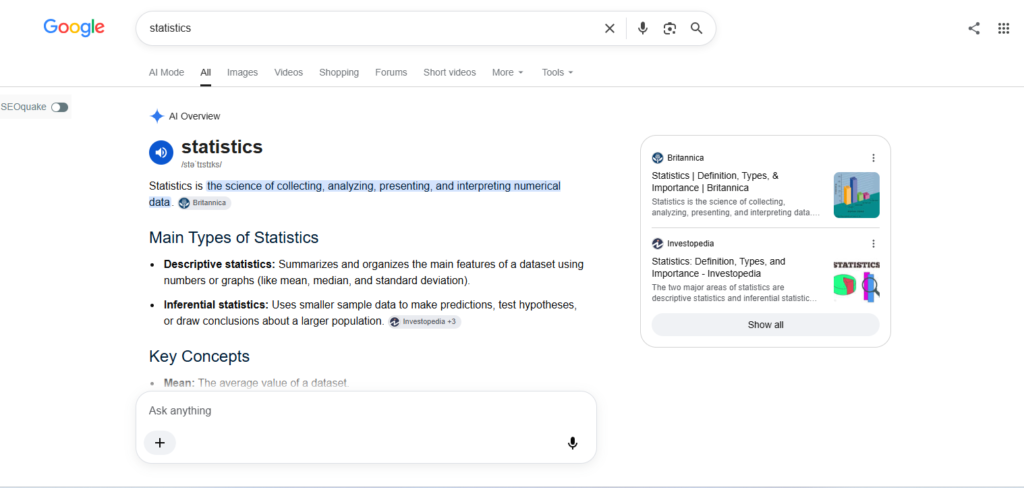
Google AI Overviews are short, AI-written answers that pop up right at the top of the search results. They’re built to pull together information from different websites, giving users a direct, summarized answer to their question without always needing them to click through to a page. The tech behind AI Overviews uses Google’s advanced large language models (LLMs), similar to what powers generative AI search. These models are trained on tons of text and code, which helps them get the context, spot the important bits, and generate text that sounds human.
The shift from the experimental Search Generative Experience (SGE) to AI Overviews means these features are now more integrated and polished. While SGE was like a test run, AI Overviews are becoming a standard part of many search queries. They usually show up for informational searches, how-to questions, and comparison requests. For example, if you search “best way to clean a cast iron skillet” or “compare iPhone 15 vs Samsung S24,” you’ll probably see an AI Overview that combines info from various articles and product pages. The AI looks at the top-ranking content for a search, pulls out the relevant pieces, and puts them into a clear summary. It’s really important to get that these summaries aren’t made up from thin air; they’re directly tied to the web pages Google’s AI thinks are the most reliable and relevant for the query.
Why AI Overviews SEO Strategy Matters for Your Traffic
The arrival of AI Overviews has big consequences for website traffic and online visibility. On one hand, an AI Overview appearing right above the usual organic results can lead to “zero-click searches.” This means users might get their answer from the AI summary and not feel the need to click any links, which could mean less traffic to individual websites. Semrush, referencing Pew Research Center data, reported that users clicked traditional search result links only 8% of the time when an AI Overview was present, compared to 15% when it wasn’t. That’s a pretty significant drop in potential click-through rates.
But, AI Overviews also offer chances for more brand visibility and organic traffic. When a website’s content is mentioned as a source in an AI Overview, it gets a prominent spot and exposure to a lot of people. Even if direct clicks go down, the brand gets linked to the answer, building awareness and trust. Plus, data from Surfer SEO shows that 52% of the sources mentioned in AI Overviews also ranked in the top 10 organic results. This suggests that having strong organic rankings is still key to being considered for an AI Overview, and being in an AI Overview can amplify that visibility. Ignoring AI Overviews optimization means you could be handing over valuable search real estate to competitors who are adapting to this new search way of doing things.
Google AI Overviews Ranking Factors: What We Know So Far
While Google keeps pretty quiet about the exact algorithms behind AI Overviews, a few key signals and best practices seem to influence whether a page gets cited. Understanding these factors is crucial for developing an effective AI Overviews SEO strategy.
One of the biggest factors is topical authority and depth of content. AI models look for sources that show they know a lot about a subject. Pages that cover a topic thoroughly, explore the finer points, and answer related questions are more likely to be seen as authoritative.
E-E-A-T (Experience, Expertise, Authoritativeness, Trustworthiness) signals are super important. Google emphasizes E-E-A-T across its ranking systems, and it’s the same for AI Overviews. Showing real-world experience (especially for product reviews or how-to guides), proving clear expertise through author credentials, building authority with citations and backlinks, and making sure your site is trustworthy overall are critical. This means having clear author bios, referencing reputable sources, and keeping your website secure and easy to use.
Structured data and schema markup are becoming increasingly important. By adding schema markup like FAQPage, HowTo, and Article schema, you provide structured, machine-readable information that helps search engines better understand your page content. This makes it easier for AI models to grab specific answers and details.
Page speed and Core Web Vitals continue to be fundamental for good search performance. Pages that load quickly and offer a good user experience are favored by Google’s algorithms, and this preference extends to how content is considered for AI Overviews. Pages that are slow or hard to navigate are less likely to be prioritized.
Lastly, using clear, concise, question-answering content formats is vital. AI models are designed to give answers. Content that’s structured to directly answer user questions, using clear headings, bullet points, and summary sections, is easier for AI to process and use for generating overviews.
How to Appear in AI Overviews: Content Structure Best Practices
To boost your chances of being featured in Google AI Overviews, you need to format your content so it aligns with how AI models pull and summarize information. Think of it as making your content as easy to digest and directly answerable as possible.
Start by using clear H2 and H3 heading hierarchies that match common search queries. If users are asking questions like “What are the benefits of meditation?” or “How to bake sourdough bread,” structure your headings to directly answer those questions. This makes it easy for AI to figure out what each section is about.
Right after your headings, try to write direct answer paragraphs. This is probably the most important tactic. Instead of long introductions or contextual paragraphs, aim to give the most direct answer to the question in the heading within the first few sentences. The AI can then easily grab this information for its summary.
Include numbered lists and bullet points for step-by-step instructions or key takeaways. AI models are good at pulling information from lists, as they represent clearly defined points or actions. For “how-to” content, this is a must.
Keep your sentences and paragraphs concise. AI models process information efficiently. Overly long, complicated sentences or rambling paragraphs can make it harder for the AI to pinpoint the core information. Shorter, punchier sentences and focused paragraphs are easier to process.
Consider using summary boxes or TL;DR (Too Long; Didn’t Read) sections at the start of your articles or key sections. These act as explicit summaries, giving a clear, condensed overview of the main points. This is a direct way to meet the AI’s need for distilled information.
Featured Snippets vs AI Overviews: Key Differences and Overlapping Strategies
It’s important to tell the difference between Featured Snippets and AI Overviews, as they’re distinct but related search result features.
Featured Snippets have been around longer and usually show up as a box at the top of the SERP, pulling a specific bit of text (often a paragraph, list, or table) from a single web page that best answers a user’s question. They’re usually more focused on a very specific question.
AI Overviews, on the other hand, are broader. They bring together information from multiple sources to give a more complete, conversational answer. As mentioned, AI Overviews are powered by generative AI and LLMs, offering a more advanced way of summarizing than traditional featured snippets.
Even with these differences, there’s a lot of overlap in the optimization tactics that work for both.
- Concise Answers: Both AI Overviews and Featured Snippets favor content that gives direct, concise answers to user queries.
- Structured Formatting: Using headings, lists, and clear paragraph structures helps both types of results. AI Overviews can pull from different structured elements across various pages, while featured snippets often grab a single, well-formatted piece of content.
- Topical Authority: While AI Overviews rely more heavily on combining info from various authoritative sources, strong topical authority is still a prerequisite for being considered for both.
- E-E-A-T: Showing E-E-A-T is crucial for both to build trust and credibility in Google’s algorithms.
Where they differ is in the scope and sophistication of the AI. AI Overviews are more likely to pull information from a wider range of pages and to process that information in a more nuanced way. Optimizing for AI Overviews often means making sure your content isn’t just a good answer, but a foundational piece of information that the AI can weave into a larger summary. So, while the strategies overlap, AI Overview optimization needs a more complete approach to content creation and authority building.
AI-Generated Search Results Optimization: Technical SEO Considerations
Beyond just formatting content, technical SEO remains a critical pillar for appearing in AI Overviews. These aspects make sure your website is crawlable, indexable, and offers a smooth user experience that Google’s AI can trust.
Implementing structured data (schema markup) is no longer optional but a strategic advantage. Specifically, `FAQPage` schema is great for questions users often ask. `HowTo` schema is invaluable for step-by-step guides, breaking down processes into manageable steps that AI can easily process. `Article` schema provides metadata about your content, like the author, publication date, and more. Using these helps search engines understand the context and intent of your content, making it prime for AI to extract.
Make sure your site is properly crawlable and indexable. Your website’s robots.txt file shouldn’t prevent Googlebot from accessing important pages. Use Google Search Console to check your site’s indexing status and find any crawling errors. If Google can’t find or index your content, it can’t be used for AI Overviews.
Optimize for mobile and page experience signals. With a lot of searches happening on mobile devices, a mobile-friendly website is a must. This includes responsive design, readable font sizes, and appropriate touch target sizes. Google’s Core Web Vitals (Largest Contentful Paint, First Input Delay, and Cumulative Layout Shift) are key metrics for page experience, and poor scores can hurt your visibility in all kinds of search results, including AI Overviews.
Use canonical tags correctly to avoid duplicate content issues. If you have similar content across different URLs, a canonical tag tells search engines which version is the preferred one. Incorrectly set-up canonicals can confuse search engines and weaken your authority.
Maintain a clean internal linking structure that reinforces topical authority. Internal links help Google understand how different pages on your site relate to each other. By linking relevant articles together, you create topic clusters that signal deep expertise in specific areas, making your content more valuable for AI to synthesize.
SGE Optimization Best Practices: Building Topical Authority and Trust
To really do well in the era of AI-generated search results, your focus needs to go beyond just on-page optimization to building a strong profile of topical authority and trustworthiness. This is where long-term SEO strategy meets the needs of generative AI.
The importance of building comprehensive topic clusters and pillar pages can’t be stressed enough. A pillar page is a broad overview of a main topic, while topic clusters are groups of content that dive into specific sub-topics related to the pillar. This structure tells Google you’re a go-to resource on a subject, making your content really valuable for AI synthesis.
Earning high-quality backlinks from authoritative domains is still a cornerstone of SEO. Backlinks are still a strong sign of credibility and authority. When other reputable websites link to your content, it reinforces your status as a trustworthy source, a critical factor for AI Overviews.
Showcasing author credentials and bios is vital for E-E-A-T. For any content that requires expertise, especially in sensitive areas like health, finance, or law, having clearly identified authors with proven experience and qualifications adds significant credibility. This transparency is something AI models can assess.
Citing credible external sources within your content not only boosts your own authority but also shows that you engage with and acknowledge the broader knowledge base. This practice signals to AI that your content is well-researched and based on established information.
Finally, regularly updating content to reflect the most current information is essential. AI models often prioritize fresh, up-to-date content, especially for topics that change quickly. Keeping your content current makes sure it stays relevant and valuable for AI synthesis. If your site offers AI visibility platforms, this is especially relevant to highlight.
Measuring Your AI Overviews Visibility and Performance
Tracking your success in AI Overviews requires tweaking your measurement strategies. Traditional metrics might not tell the full story.
Google Search Console is your main tool for insights. While it doesn’t have a specific “AI Overviews” report (yet), you can look for patterns in your impression and click data for queries that commonly trigger AI Overviews. A noticeable drop in CTR for a particular keyword might mean users are finding their answers in AI Overviews. Conversely, if your site is mentioned in an AI Overview, you might see an overall increase in impressions even if direct clicks don’t immediately jump up.
Third-party SEO tools are starting to offer AI Overview tracking features. These tools try to figure out when your content is showing up in AI Overviews for certain keywords. Keep an eye on these developments as the landscape evolves.
Manually monitoring SERPs for your target keywords is still a valuable, though time-consuming, practice. Regularly check the search results pages for your most important queries to see if AI Overviews are present and, if so, whether your content is being cited.
When looking at changes in CTR and organic traffic, consider the impact of AI Overviews. A dip in clicks could be because users are happy with AI-generated answers. However, if your brand is being cited, this exposure can contribute to brand recall and future direct traffic, even if immediate click-through rates from the AI Overview itself are low. The goal isn’t just to get clicks, but to be a recognized and trusted source within the AI-generated search experience.
Conclusion
The move towards AI Overviews is a huge transformation in how users interact with search engines. To do well, a modern SEO strategy needs to include these new realities. It’s not enough anymore to just aim for traditional organic rankings. Optimizing for AI Overviews requires a multifaceted approach: creating deeply authoritative, E-E-A-T-driven content, structuring that content for clear, direct answers, and putting in place solid technical SEO practices.
By focusing on clear headings, direct answer paragraphs, structured data, and building real topical authority, you can seriously improve your chances of being cited in AI-generated search results. Remember that this is an evolving area, so staying informed and adapting your strategies will be key to long-term success. Start by reviewing your current content against these best practices, identifying keywords with good potential, and treating AI Overview optimization as an ongoing, iterative process rather than a one-time fix. Your visibility in the future of search depends on it.
FAQs
- Does appearing in an AI Overview guarantee more website traffic?
Not directly. While being cited in an AI Overview increases brand visibility and can drive traffic, users might find their answer within the overview itself and not click through. However, increased visibility can lead to future direct traffic and brand recognition. - Can I opt my website out of being used in Google AI Overviews?
Right now, there’s no direct way to opt out of being considered for inclusion in AI Overviews. Google aims to provide comprehensive answers, and if your content is deemed relevant and authoritative, it might be used. - How is optimizing for AI Overviews different from traditional SEO?
Traditional SEO heavily focuses on ranking in the regular blue links. AI Overviews need a focus on content structure that allows AI to easily pull and combine information, along with traditional factors like authority and E-E-A-T. It’s about being a source for the AI summary, not just a link in the results. - How long does it take to see results from AI Overviews optimization efforts?
SEO results, in general, take time. For AI Overviews, improvements in content structure, authority building, and technical SEO can start to show an impact within weeks to months, but consistent effort is needed. - Do backlinks still matter for appearing in AI-generated search results?
Yes, backlinks are still a critical signal of authority and trustworthiness, which are key factors for content to be considered for AI Overviews. High-quality backlinks contribute to your overall domain and page authority. - Should I use schema markup specifically to improve my AI Overviews visibility?
Yes, implementing relevant schema markup, such as FAQPage, HowTo, and Article schema, is highly recommended. It helps search engines understand your content better, making it easier for AI to pull and use the information for overviews.

I’m an SEO specialist with 7+ years of experience in search engine optimization, digital marketing, content strategy, and AI-powered marketing. I share practical insights on AI tools, SEO, automation, content marketing, and emerging technologies to help businesses and marketers improve their online presence and stay ahead of the latest digital trends.