
In the broadest sense, an agent is something that acts. A human real estate agent acts on your behalf to find a home. A travel agent books your ideal vacation. In Artificial Intelligence, an agent does the same — but instead of a person, it’s a piece of software making decisions and taking actions to reach a goal.
Three things define any true agent:
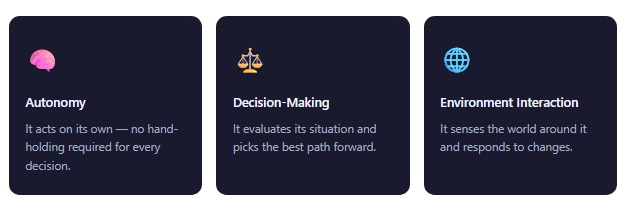
Think of a thermostat: it checks room temperature (perceives), compares it to your setting (decides), and turns the heating on or off (acts). That’s an agent — a very simple one, but an agent nonetheless.
Now imagine that thermostat learned your preferences, predicted when you’d be home, and adjusted itself weeks in advance. That’s an AI agent — and that’s exactly what modern systems are becoming.
Types of Agents (With Examples)
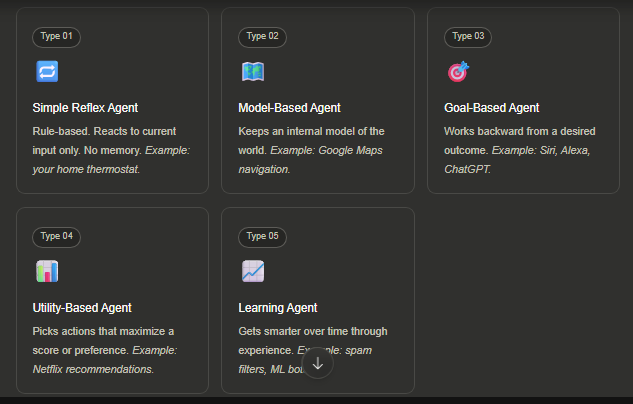
Not all agents are created equal. They range from dead-simple rule-followers to sophisticated learners. Here are the five main types:
Simple Reflex Agents
These are the most basic agents. They react to what’s happening right now using pre-defined rules — no memory, no learning, no planning. If this, then do that.
Example: A home thermostat. It sees the temperature is below 20°C and turns on the heat. Simple, fast, reliable — but limited.
Model-Based Agents
These agents keep an internal model of the world. They don’t just react to the present — they remember where they’ve been and use that context to make smarter decisions.
Example: GPS navigation apps like Google Maps. They track your current position, remember the route, and adapt in real time when you take a wrong turn.
Goal-Based Agents
Rather than just reacting, goal-based agents work backward from a desired outcome. They evaluate options and choose the path most likely to achieve the goal.
Example: AI assistants like Siri, Alexa, and ChatGPT. They receive your request, figure out the best way to fulfil it, and act accordingly.
Utility-Based Agents
These agents don’t just achieve goals — they try to achieve them as well as possible. They use a “utility function” to score possible outcomes and pick the one with the highest value.
Example: Recommendation systems on Netflix or Spotify. They don’t just suggest “a video” — they try to predict the exact video you’ll enjoy most.
Learning Agents
The most advanced type. Learning agents improve with every interaction, building knowledge over time through experience — much like humans do.
AI Agents Explained: How They Work
Every AI agent — from a humble chatbot to a self-driving car — follows the same fundamental loop:

Under the hood, three components power this cycle:
Sensors
The inputs — cameras, microphones, API data, or text prompts that let the agent observe its environment.
Actuators
The outputs — speakers, robotic arms, database writes, or API calls that let the agent change the world.
Processing Brain
The decision engine where ML models, rules, and data combine to produce the right action.
Modern AI agents are powered by large language models (LLMs) that give them an almost human-like ability to reason in natural language — which is why 2026’s agents feel so remarkably capable compared to anything we’ve seen before.
How AI Agents Are Used in Real Life
You’ve already interacted with dozens of agents today without realising it. Here’s where they show up most:
When you chat with a brand’s support bot, get a product suggestion on Amazon, or ask Google Assistant to set a reminder — you’re working with AI agents. And as these systems become more capable, they’re moving from reactive helpers to proactive partners that complete complex tasks on your behalf.
Latest AI Agents Updates: 2026 Trends
The agent landscape has changed dramatically just in the past year. Here’s what’s defining the field in 2026:
Benefits of Using AI Agents
The business case for AI agents is compelling. Here’s why organisations of every size are adopting them:
✅ Key Benefits
- Automates repetitive, time-consuming tasks so humans can focus on what matters
- Dramatically improves operational efficiency — works 24/7 without fatigue
- Reduces labour and operational costs at scale
- Makes faster, data-backed decisions with less human error
- Scales without proportional cost increases
Challenges to Consider
- Heavily dependent on high-quality data to function correctly
- Ethical concerns around bias, fairness, and transparency
- Security and privacy vulnerabilities if poorly designed
- Lacks genuine human empathy, creativity, and judgment
Can fail unpredictably in novel or edge-case situations
The Future of AI Agents
We’re still in the early innings. The next decade will bring agents that are genuinely autonomous across long, complex tasks — not just answering questions, but running projects, managing teams, and driving business strategy.
The most exciting shift isn’t AI replacing humans — it’s the rise of human-AI collaboration. Agents will handle the cognitive gruntwork while humans focus on creativity, ethics, and high-level thinking.
Three trends to watch closely:
- Fully autonomous systems — agents that manage entire workflows independently, from research to execution to reporting
- Deep human-AI collaboration — not AI vs humans, but AI amplifying human capabilities in every profession
- AI-native businesses — companies built from day one around agent-powered operations will dominate their sectors
Businesses that master this collaboration first will build the most durable competitive advantages of the next decade.
Wrapping Up
An agent, at heart, is just anything that perceives and acts. But in 2026, AI has turned that simple idea into one of the most transformative forces in technology — from smart home devices to autonomous coding assistants.
The more you understand agents — how they’re built, how they think, where they succeed, and where they fall short — the better positioned you’ll be to use them to your advantage. Stay curious, keep experimenting, and remember: the best way to learn AI is to use it.
Frequently Asked Questions
What is an agent in AI?
What are AI agents explained in simple terms?

I’m an SEO specialist with 7+ years of experience in search engine optimization, digital marketing, content strategy, and AI-powered marketing. I share practical insights on AI tools, SEO, automation, content marketing, and emerging technologies to help businesses and marketers improve their online presence and stay ahead of the latest digital trends.